

4.9 Ratings based on 1,000+ reviews
On-Demand Home Services App Development Services
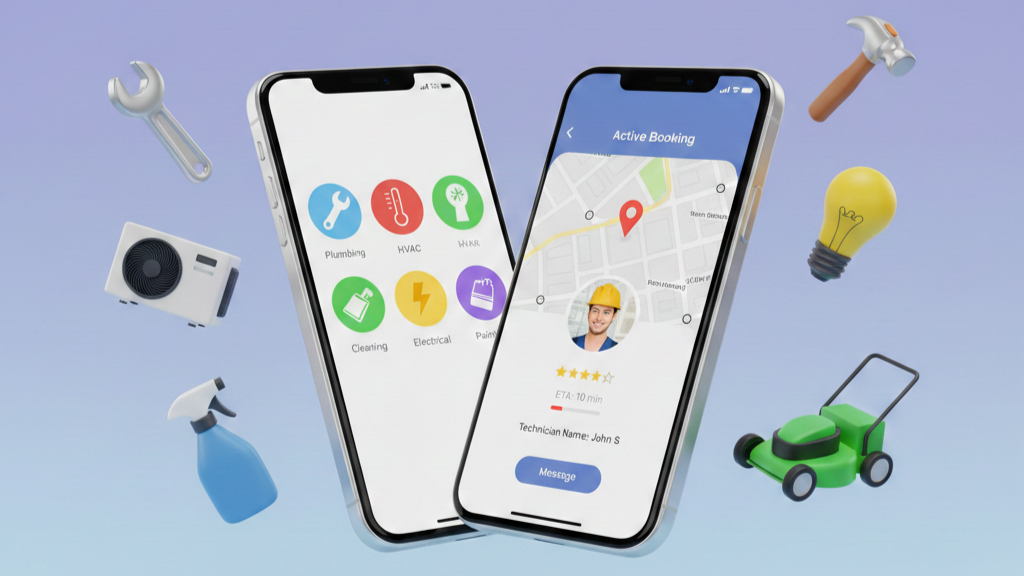
Professional on-demand home services app development isn’t just about going digital it’s about building a platform that 10x’s your revenue, streamlines operations, and dominates your local market. Our custom home services app development services empower plumbing, HVAC, cleaning, electrical, and handyman businesses to capture more bookings, increase efficiency by 40-50%, and deliver exceptional customer experiences that drive loyalty.
Services
Comprehensive On-Demand Home Services App Development Services

iOS & Android Native Applications
Our home services app development company builds separate native apps for iOS and Android, ensuring optimal performance and seamless integration with device capabilities. Unlike hybrid solutions, our native approach delivers faster load times, smoother interactions, and better user retention.

Customer-Facing Applications
The customer app features intuitive booking flows, real-time service provider tracking, transparent pricing, multiple payment options, service history, and instant communication all designed to reduce booking abandonment by 40% compared to traditional methods.

Service Provider Applications
Technician apps include smart job routing, digital work orders, photo documentation, electronic signatures, inventory management, earnings tracking, and in-app navigation tools that increase daily job completion by 25-35%.

Admin Dashboard & Management Platform
Web-based control centers provide complete oversight: real-time job monitoring, provider management, dynamic pricing controls, promotional campaign management, comprehensive analytics, and customer support tools.
Our Features
On-Demand Service App Development Features
Advanced Booking & Scheduling
Real-time availability matching
Recurring appointment automation
Emergency service prioritization
Multi-service booking capabilities
Smart calendar integration
Automated reminder systems
Intelligent Dispatching & Routing
AI-powered job assignment algorithms
Route optimization reducing drive time by 30%
Skills-based provider matching
Workload balancing across teams
Geographic zone management
Traffic-aware scheduling
Secure Payment Processing
Multiple payment gateway integration
Digital wallet support (Apple Pay, Google Pay)
Subscription and recurring billing
Split payment options
Automated invoicing
PCI-DSS compliance

Real-Time Communication
In-app messaging between customers and providers
Push notifications for job updates
SMS integration
Photo and video sharing
Automated status notifications
Emergency contact features

Rating & Review System
Post-service feedback collection
Provider performance ratings
Quality assurance monitoring
Review response management
Reputation building tools
Ready to Scale Your Home Services Business?
Join 50+ service providers who’ve transformed their operations with our custom app development. See how we can help you capture more bookings, increase efficiency, and dominate your market
Home Services App Development Technology Stack
Our on-demand home service app development utilizes enterprise-grade technologies:
Backend Development
Scalable cloud infrastructure (AWS, Google Cloud, Azure)
RESTful API architecture
Microservices for flexibility
Real-time database synchronization
WebSocket for instant updates
99.9% uptime guarantee
Frontend Development
Swift for iOS development
Kotlin for Android development
React or Angular for admin dashboards
Responsive design principles
Offline functionality
Progressive enhancement
Integration Capabilities
Payment processors (Stripe, PayPal, Square, Authorize.net)
SMS gateways (Twilio, MessageBird)
Email automation (SendGrid, Mailchimp)
CRM systems (Salesforce, HubSpot)
Accounting software (QuickBooks, Xero)
Google Maps and geolocation services
Industries We Serve
Industry-Specific On-Demand App Development Solutions
01
Plumbing & HVAC App Development
Custom features for emergency dispatch, seasonal maintenance scheduling, equipment tracking, diagnostic tools, and warranty management.
02
Cleaning Services App Development
Recurring booking automation, multi-location management, team coordination, supply inventory, quality checklists, and customer preference tracking.
03
Electrical Services App Development
License verification, code compliance documentation, material estimation, circuit mapping, before/after photos, and safety protocol integration.
04
Landscaping App Development
Weather-aware scheduling, seasonal service packages, property measurements, equipment scheduling, and project timeline management.
05
Handyman Services App Development
Multi-skill job matching, project estimation tools, material ordering, hourly/fixed pricing options, and portfolio showcasing.
06
Multi-Service Platform Development
Unified platforms managing multiple service categories with dynamic provider credentialing, service-specific workflows, and variable pricing models.
Ready to Scale Your Home Services Business?
Join 50+ service providers who’ve transformed their operations with our custom app development. See how we can help you capture more bookings, increase efficiency, and dominate your market
Development Process
Our On-Demand Home Services App Development Process
Discovery & Planning
We analyze your business model, target market, competitive landscape, and growth objectives. Our home service app developers conduct stakeholder interviews, workflow analysis, and technical requirements gathering to create a comprehensive development roadmap.
Strategy & Architecture
Custom architecture design for your specific needs whether dynamic pricing engines, complex multi-provider scheduling, or subscription management. We plan scalable infrastructure that supports your 3-5 year growth trajectory.
UX/UI Design
User experience design optimized for conversions. Our designers create intuitive interfaces tested with real users, ensuring both customers and service providers navigate effortlessly through every interaction.
Development & Integration
Agile development methodology with bi-weekly sprints, regular progress updates, and continuous stakeholder feedback. Our on-demand app developers build robust backends, native mobile apps, and comprehensive admin systems simultaneously.
Quality Assurance
Comprehensive testing across devices, operating systems, and usage scenarios. Functional testing, performance testing, security audits, load testing, and user acceptance testing ensure reliability before launch.
Launch & Deployment
Strategic app store optimization, submission management, marketing integration, and coordinated rollout. We ensure your home services mobile app meets all technical requirements and positions competitively in search rankings.
Our Services
What Makes Our Home Services App Development Different
10x Revenue Growth Potential
Our clients typically experience 3-5x booking increases in year one as the app removes friction from the customer journey. Strategic features like subscription models, loyalty programs, and upselling automation create predictable recurring revenue that can multiply annual revenue by 10x over 3-5 years.
Operational Efficiency That Scales
Automated dispatching, intelligent routing, and digital workflow management reduce operational overhead by 40-50%. What once required multiple coordinators now runs smoothly with minimal intervention, allowing you to scale without proportional cost increases.
Data-Driven Business Intelligence
Comprehensive analytics reveal customer behavior patterns, peak demand periods, service profitability, provider performance, and market opportunities. Make informed decisions about pricing, staffing, marketing, and expansion based on real-time data.
Testimonials & Reviews
Hear From Our Happy Clients: Their Stories!

Prashant Jadhav
Solarize

Solarize has completely transformed the way we manage our farmer records and installations. Before this system, our operations were buried in Excel chaos and endless phone calls. Now, we have real-time visibility into inspections, installations, and technician performance. What impressed us most was how the platform scaled from one vendor ERP into a SaaS-ready system. It feels like a tool built exactly for our industry not a generic CRM. Truly game-changing for us.

DA Advertising Agency
Creative Partner
Working with them has been a game-changer for DA. As an advertising agency, we are strong in media and client strategy, but we needed a partner who could bring world-class branding, packaging, and UI/UX expertise. They built our website, created brand kits for major clients like Orient Cement and Yes Bank, and supported us with premium packaging designs. The consultation extended our creative capabilities and allowed us to take on projects we otherwise couldn’t. They are our behind-the-scenes creative backbone, and we couldn’t imagine delivering at this level without them

Wall and Tone
AI-Powered E-commerce
We always felt that buying wall art online was impersonal and risky because customers couldn’t visualize how it would look in their homes. Wall and Tone solved this brilliantly. The AI preview tool is a delight for our customers, giving them confidence before buying. The AI art generation keeps people engaged, and the artist marketplace has given us a fresh edge. The branding, UI, and overall experience feel premium exactly how we wanted our store to stand apart from mass-market platforms. It’s not just an online shop; it feels like a digital gallery.

BlackArc
Consumer Electronics Brand
We started BlackArc with just an idea and nothing else. From scratch, they built our brand identity, designed our entire product ecosystem, and created packaging that competes with global names. Headphones, speakers, chargers, mobile accessories every product carries a consistent design DNA. The packaging looks premium on shelves, and the branding gives us a modern, bold personality. They didn’t just design products; they created a brand we can proudly take to market. BlackArc exists today because of this partnership
Cunieflow
Global SaaS ERP
What we love about Cunieflow is that it is not tied down to one industry. Most ERPs are either too rigid or too generic, but this system adapts to any business where fieldwork is critical. The dashboards give us clarity, the mobile app empowers our team in remote areas, and the communication layer builds transparency with our clients. It feels like an ERP designed for the realities of the field, not the office. Even though it’s an innovation in progress, it already gives us the confidence that we are building on the right foundation for global scale.

Fine-Dine Restaurant
App Redesign
Our old app was outdated and didn’t reflect the premium experience we deliver in our restaurant. The redesign changed everything. The new interface feels elegant, intuitive, and truly aligned with fine dining. Our guests now find it effortless to book tables, check today’s specials, and explore our events gallery. Since the launch, bookings through the app have increased by 28%, and gift card sales during festive seasons have gone up significantly. The app finally feels like an extension of our restaurant, not just a utility
On-Demand Home Services App Development Cost & ROI
While custom on-demand home service app development requires upfront investment, our clients achieve positive ROI within 6-12 months through:
- Increased Revenue Streams
- Reduced Operational Costs
- Improved Cash Flow

Security & Compliance in Home Services App Development
Professional on-demand app development prioritizes security and regulatory compliance:
Data Protection
End-to-end encryption for all transactions
GDPR and CCPA compliance frameworks
Secure authentication protocols
Regular security audits and penetration testing
Data backup and disaster recovery
Payment Security
PCI-DSS Level 1 compliance
Tokenization of sensitive card data
Fraud detection and prevention
Secure payment gateway integration
Transaction monitoring systems
Background Check Integration
Provider verification systems
License and certification tracking
Insurance documentation management
Compliance reporting tools
Why Businesses Choose Our Home Services App Development Company
01 Proven Track Record
Over a decade of experience in on-demand service app development, delivering solutions that collectively process millions of bookings annually for clients ranging from single-city operations to national franchises.
02 Industry Expertise
Our developers understand home service business operations, seasonal demand patterns, pricing strategies, and customer expectations ensuring every feature solves real business challenges.
03 Scalable Architecture
We build platforms that grow with your business. Whether you’re serving one city or expanding nationally, our architecture supports unlimited users, service providers, and transactions without performance degradation.
04 Transparent Communication
Regular progress updates, collaborative development approach, and dedicated project management ensure you’re informed and involved throughout the on-demand app development process.
05 Post-Launch Partnership
Your success is our success. We provide ongoing support, feature enhancements, and strategic guidance to ensure your home services mobile app remains competitive and profitable.
Get Started with Professional On-Demand Home Services App Development
Ready to transform your home services business with custom on-demand app development that drives measurable results? Our development process begins with a comprehensive strategy session where we assess your specific needs, competitive position, and growth objectives.
Schedule your free consultation with our on-demand home service app development experts and discover how a custom platform can become your most profitable business investment.
Meet Our Team

Darshan
Founder – CEO

Anand
Founder – COO

Krishna
Founder – CTO
Frequently Asked Questions
Got Questions? We’ve Got Answers.
Lorem ipsum is placeholder text commonly used in the graphic, print, and publishing industries for previewing layouts and visual mockups.
How long does on-demand home services app development take?
Custom development typically takes 4-6 months from initial consultation to launch, depending on feature complexity and integration requirements.
What’s the difference between custom app development and template solutions?
Custom on-demand service app development builds around your specific business needs, while templates force you to adapt to predefined limitations. Custom solutions scale better and deliver superior ROI.
Can you integrate with our existing business systems?
Yes, our home services app development includes integration with CRM, accounting, payment processing, and other essential business tools.
What ongoing support do you provide after launch?
We offer comprehensive support packages including monitoring, maintenance, security updates, feature enhancements, and technical assistance.
How do you ensure the app is secure?
Our on-demand app development follows industry-standard security protocols including encryption, secure authentication, PCI-DSS compliance, and regular security audits.